The gun struck the pavement and fired.
Tyler Eifert never even touched the trigger. He didn’t even have time to reach for the falling pistol before it tumbled from his front seat to the parking lot below. The 9mm bullet tore into the lower left side of his chest, traveled upward through muscle, nerves and blood vessels and stopped somewhere deep inside his armpit. In those first seconds, he didn’t even fully grasp what had just happened.
For a split second, there was only the blast, the violent snap of his arm into the air and confusion. Then came the blood. Lots of it. Bright red and pouring fast.
Eifert, a certified firearms instructor who worked at Calibers gun range in North Carolina, had been running about five minutes late that morning. In the rush, he had abandoned part of his normal routine. He usually put on soft body armor before entering the range and carried his gear inside in an orderly way. Instead, he moved his Glock 26 from the center console of his truck to the passenger seat along with his eye protection, hearing protection, water bottle, books and other equipment.
When he arrived, he walked around the truck and opened the passenger door. The pistol fell from the seat, struck the ground and discharged.
The bullet entered beneath his left chest and traveled upward. Eifert initially thought he had been hit only in the armpit because that was where he felt the impact. Then he saw how much blood he was losing. That was the moment panic could have taken over.
Instead, his mind focused on his training.
“I go with a big trauma bag everywhere I go,” Eifert said. “I love medical stuff. I’m super interested in it.” As a result, he’s also well trained in emergency first aid, especially how to treat a gunshot wound.
He reached into the back seat, grabbed the bag and ran toward the range entrance, pounding on the door for help. He knew in his condition, it didn’t make sense to go inside, though that is the response many of us would have had. Emergency personnel arriving on the scene once 911 was called would be able to get to him more quickly, and perhaps more importantly, get him loaded on a stretcher on in an ambulance for transport to a hospital much more quickly outside. The clock was already running. Severe blood loss can become fatal within minutes.
Eifert knew all of that but tried to keep his thoughts focused on what he needed to do.
Stopping the Bleeding
Employees rushed outside when they heard Eifert beating on the door. He immediately began issuing instructions.
“Call 911,” he first instructed. His hands were so covered in his own blood; he couldn’t even dial his cell phone.
“Open the trauma bag.”
Believing the majority of the blood to be flowing from his armpit where he felt the bullet, he grabbed a tourniquet and applied it himself.
“Typically, with an armpit wound, you would pack and hold pressure to slow the bleeding, but with how much blood I was losing, I knew I was going to pass out pretty quick,” Eifert says. “So, I just put a tourniquet in my armpit, not to cut off blood as much as to hopefully keep pressure on where I thought the wound was.
Fortunately, they're super easy to put on, so I was able to put it on quickly with my good hand.”
Meanwhile, he continued to instruct the others on how to help him.
“That kind of helped my brain stay focused throughout the entire thing,” he says. The problem was, even with the tourniquet on, he was still losing a lot of blood.
“You’ve got to find the hole,” he told the two men.
One coworker began cutting away Eifert’s shirt using a pocketknife. Eifert’s trauma shears had fallen from the outside webbing of his bag as he ran toward the door. Even lying on the ground and bleeding heavily, he warned his coworker not to cut the tourniquet—or stab him while slicing through the shirt. It was a moment of almost absurd clarity inside an otherwise terrifying scene.
Then another man appeared.
It was a customer who had been at the range shooting. He was a former 82nd Airborne medic and as luck—or divine intervention—had it, he happened to walk out of the range and into the unthinkable scene just moments after Eifert’s coworkers began helping him.
The man went immediately to work, relying on his training. Without instruction, he broke out his own shears, began cutting away Eifert’s shirt, ran his hands across Eifert’s chest locating the entry wound and was already pulling out a chest seal before Eifert could instruct him on what to do. The wounded instructor didn’t need to. The medic was already ahead of him. Once the chest was sealed, the man rolled Eifert over to check for a possible exit wound on his back.
There was none. The bullet had entered the chest and traveled upward beneath the skin and muscle before stopping near the armpit.
“We’ve Got to Go”
Firefighters arrived first, followed by EMS. They began assessing him, but Eifert assured them they had already done all of that. They needed to go. He knew the amount of blood he had lost and time was of the essence if he was to survive this.
“We’ve got to go,” he kept telling the responders. “I need blood. I need fluids. We’ve got to go.”
Paramedics put him on oxygen and quickly loaded him onto the stretcher.
“I was soaked in blood. The ground was soaked in blood. Seeing that amount of blood coming out of somebody usually doesn’t go super good,” Eifert says.
Once inside the ambulance, paramedics started an IV and administered medication. Eifert called his wife during the ride to tell her which hospital would receive him. He tried to keep his voice calm, although fear was finally beginning to push through his controlled exterior.
“I was pretty nervous,” he admits. “I was trying not to show it.”
At the hospital, physicians went to work, removing the tourniquet and chest seal while evaluating the wound. When the seal came off, blood poured across his chest.
“That chest seal absolutely was holding blood in,” Eifert said.
He received three units of blood and two units of plasma. Doctors also administered tranexamic acid, commonly known as TXA, to help support clotting. A CT scan revealed how extraordinarily fortunate he had been.
The bullet had not struck a lung. It had not broken a bone. It had even missed the major artery running through the area. It had damaged smaller arterial vessels, nerves and muscle before losing enough energy to remain lodged near his armpit.
Eifert didn’t even require surgery. Doctors opted to leave the bullet right where it was, because removing embedded projectiles can sometimes create more risk than leaving them alone.
The instructor spent approximately 36 hours in the hospital. His wound remained open to allow accumulated blood to drain, requiring his wife and father to change dressings four or five times a day during the early portion of his recovery at home. For weeks, it continued bleeding.
Eifert described his injuries as the “most unlucky, lucky thing” that had ever happened to him. He had suffered massive blood loss and a bullet remained inside his body, yet the projectile had threaded through one of the most vulnerable areas of his upper torso without destroying a lung, shattering bone or severing a major vessel.
Luck mattered. But so did preparation.
Carry the Equipment—Then Learn to Use It
Eifert had completed military combat lifesaver training, had experience as a volunteer firefighter and maintained a strong personal interest in emergency medicine. That foundation helped him recognize arterial bleeding, understand the limits of a tourniquet in a junctional wound, direct other people and identify the need for a chest seal.
But many people won’t have that level of knowledge. But maybe they should. The first step is buying a quality trauma kit and keeping it with you at all times. But buying a trauma kit and throwing it behind the seat of your vehicle is only half of the equation. The other, and perhaps even more important half, is being trained how to use it.
A gun owner should know what is inside the kit, how each item works and where everything is located. Family members, coworkers and regular shooting partners should know, too. Supplies should be inspected, organized and replaced when damaged or expired.
At minimum, Eifert recommends carrying a quality tourniquet and knowing how to apply it. A more complete individual first-aid kit should include wound-packing gauze, pressure dressings, chest seals, gloves and secured trauma shears. The exact equipment matters less than choosing reputable supplies and receiving hands-on instruction in their proper use.
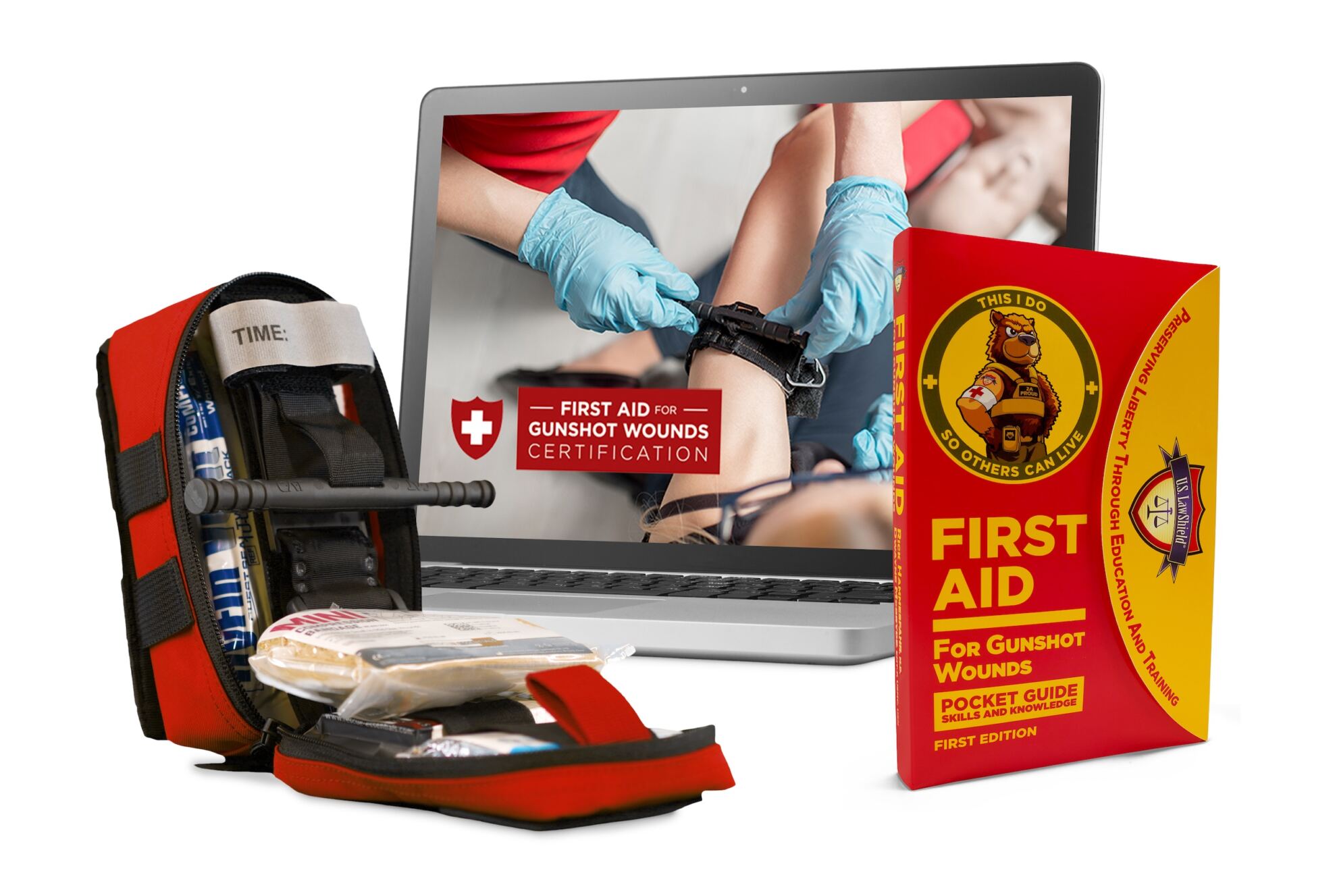
U.S. LawShield’s Emergency First Aid for Gunshot Wounds seminar is designed around that problem. The course includes live instruction and hands-on demonstrations covering wounds to the arms, legs, chest, abdomen, head and neck, along with shock control and safe positioning until EMS arrives. The program was developed by Rick Hammesfahr, M.D., a former chairman of the Curriculum and Examination Board for U.S. Special Operations Command.
U.S. LawShield lists upcoming Emergency First Aid for Gunshot Wounds seminars through its nationwide event directory. Other organizations such as the American Red Cross and the American College of Surgeons’ Stop the Bleed program.
Even with training, call 911 as quickly as possible, follow dispatcher instructions and provide only the emergency care you have been trained to perform until professional help arrives. But do something.
Eifert’s case illustrates the uncomfortable gap that exists between injury and rescue. Paramedics may be fast, skilled and well-equipped, but they cannot control bleeding while they are still driving toward you. Until they arrive, the people already at the scene are the emergency response. One day, that person could be you.
The Kit Beside the Gun
Following the accident, Calibers made U.S. LawShield’s trauma course mandatory for employees, according to Eifert. He also began preparing to provide additional in-person instruction.
The value of that decision became apparent quickly. After Eifert returned to work, the range encountered other serious medical emergencies, including a severe hand injury in which a tourniquet was used and a heart attack that required an immediate response.
Gun owners spend considerable time choosing firearms, optics, ammunition and holsters. They debate bullet performance down to fractions of an inch. They practice drawing, reloading and clearing malfunctions. All of that has significant value.
But don’t ignore the other what ifs nobody likes to talk about. What if somebody is hit by a ricochet or shrapnel. What if when hunting somebody mistakes a person for game. What if there is an accidental discharge that strikes someone. Be prepared for every scenario as a gun owner. Heck, be prepared for every emergency scenario that you can simply as a good human being. We all want to help someone when we can.
A trauma kit should be as normal in a range bag as hearing protection. Medical training should stand alongside firearms training.
Tyler Eifert was fortunate that morning. The bullet missed what it could have destroyed. A former combat medic walked through the door at exactly the right moment. EMS arrived before Eifert’s body surrendered to the blood loss. And when seconds were disappearing in a pool of blood outside a North Carolina gun range, that training bought Tyler Eifert the one thing he desperately needed in that moment. Time.
Find an Emergency First Aid for Gunshot Wounds seminar near you through the U.S. LawShield events page: https://ww2.uslawshield.com/events/
More to the Story
A Modified Gun and a Lesson for Everyone
The pistol Tyler Eifert had with him that day was a secondhand Glock 26 he had recently purchased from a private owner. The previous owner had fitted the gun with an aftermarket trigger and the frame had also been stippled before Eifert acquired it.
For the record, most modern handguns, including the Glock 26, are very safe firearms, even when dropped. A properly functioning modern handgun should not discharge merely because it falls and strikes the pavement. Eifert believes previous alterations may have compromised part of the trigger or internal safety system, although the precise mechanical failure was not definitively established.
He does not blame Glock. He also does not blame the previous owner. He does, however, accept that he carried and used a modified firearm without knowing exactly how the work had been performed and that the accident began with an avoidable handling decision he made in his haste to get to work that day. The gun was loose on a passenger seat rather than secured in a holster or container that covered the trigger and prevented the firearm from falling when the door opened.
Five minutes late. A disrupted routine. A loose gun. An unknown modification. None of those things alone seemed momentous that morning. Together, they nearly killed him.
Eifert has not resumed using that Glock. He may never use it again. He also admitted the experience left him a bit anxious around loaded firearms, something that might surprise people who imagine an experienced instructor will immediately shrug off an accident and return to normal. That is not how trauma works. He knows it will take time, but he's getting there.
Confidence, once shaken, must be rebuilt honestly and deliberately, and Eifert shared his story because he felt it was a critical lesson other gun owners could learn from. No matter how experienced with firearms you may be, safety and preparedness must always be at the forefront of every shooter’s thought and action.